Pouring Concrete in Cold Weather: What to Do and What It Costs
Published · Updated
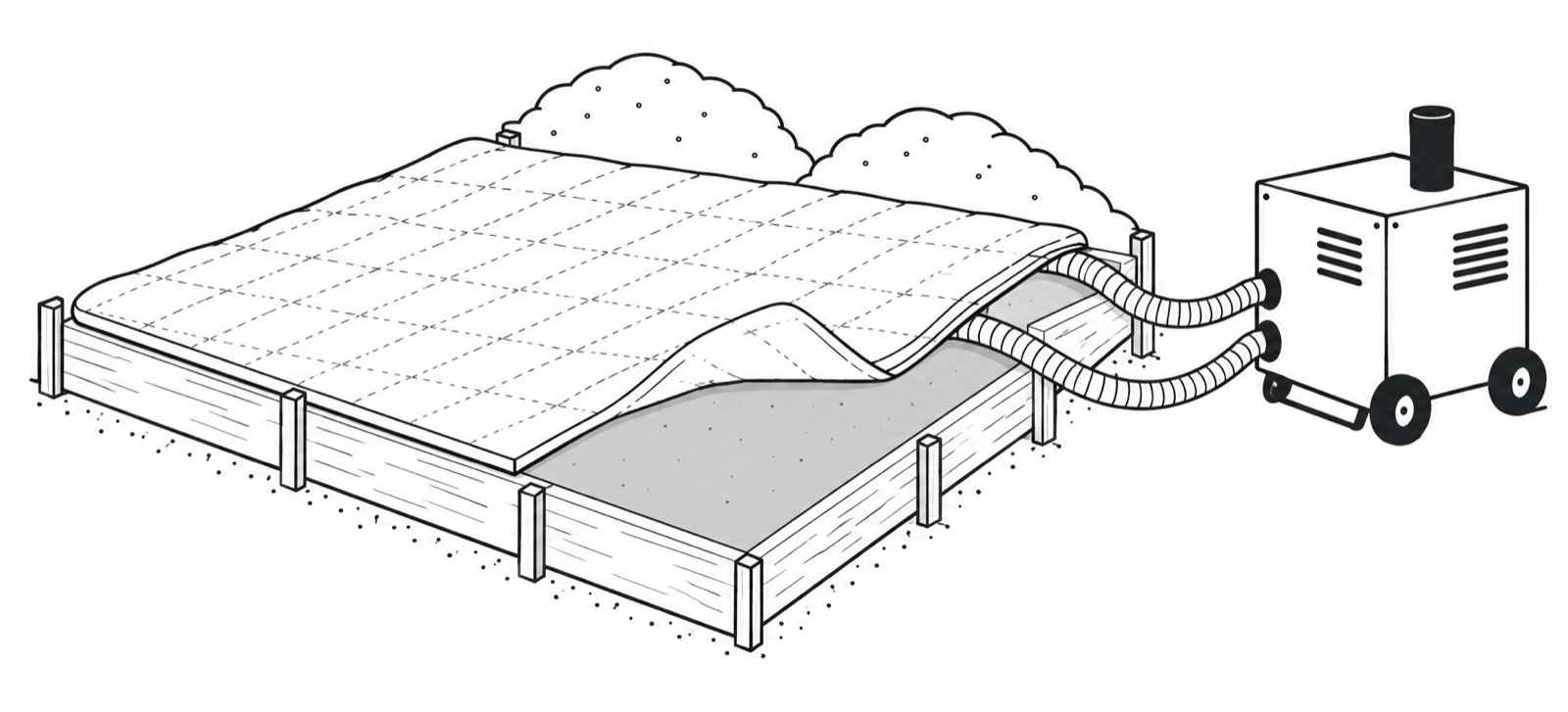
Pouring concrete in cold weather works. The rule is that the slab must not freeze until it has reached about 500 psi, a strength the American Concrete Institute (ACI) says most well-proportioned mixes gain within 48 hours when the concrete is at 50°F.
Everything below follows from that rule: place the concrete warm, pour onto ground that is not frozen, and keep the slab covered until it is strong. A winter pour also costs more. The last sections price that, using supplier price lists with dates and sources.
Can you pour concrete in winter?
Yes, on those three conditions. The danger is early freezing. Fresh concrete freezes at about 25°F, and NRMCA says concrete that freezes young can lose more than half of its potential strength and will not be durable.
ACI gives the safe point more exactly. Concrete protected from freezing until it reaches 500 psi will not be damaged by a single freeze and thaw cycle (ACI 306R-16, section 3.2). Colder concrete gains strength more slowly, so it takes longer to get there.
Winter has one upside. ACI notes that concrete placed cold, kept from freezing and cured long enough has the potential to end up stronger and more durable than concrete placed warm (section 1.1).
The catch is cost and effort. ACI names two kinds of added cost: potentially lower crew productivity, and extra products such as insulating blankets or heaters (section 3.3). What a cold-weather pour adds to the price puts numbers on them.
How ACI defines cold weather for concrete
ACI’s current definition is short. Cold weather is when the air temperature has fallen to, or is expected to fall below, 40°F during the protection period. The protection period is the time recommended to keep new concrete from being harmed by the cold (ACI 306R-16, section 2.2). That edition came out in September 2016 and replaced 306R-10.
An older, stricter definition is still in circulation. It asks for several consecutive days with an average daily temperature below 40°F, and air that does not rise above 50°F for more than half of any day. NRMCA’s CIP 27 says more than three days. Cemex’s 2023 technical bulletin says three.
The two definitions treat a single cold night differently. By the current one, a night forecast below 40°F in the days after your pour is enough. So check the forecast for the days after the pour as well as the morning of it.
The minimum temperature to pour concrete
The minimum temperature to pour concrete is not an air temperature. NRMCA’s guide does not set one that closes the pouring season. It sets a minimum for the concrete itself as it is placed, and that depends on how thick the section is. ACI adds that its own times and temperatures are not exact values for every situation (section 3.2).
| Section size | Concrete temperature as placed |
|---|---|
| Less than 12 in | 55°F |
| 12 to 36 in | 50°F |
| 36 to 72 in | 45°F |
A residential slab is under 12 inches thick, so the first row applies. Concrete should not be placed more than 20°F above these numbers either. NRMCA says hotter concrete needs more mixing water, loses slump faster and cracks more easily. ACI states the same 20°F limit (section 4.3).
The plant sets the concrete pour temperature. Cemex calls hot water the easiest and most efficient way to raise it, with water kept under 140°F. Ask the plant what temperature the load will have when it arrives.
Air temperature still matters. ACI says the protection needed rises as the air gets colder (section 1.1).
How to prepare the site before the pour
Clear snow and ice off the subgrade and the forms. NRMCA says every surface that touches the concrete should be above freezing, and that this may mean insulating or heating the ground first. Cemex suggests covering the subgrade with insulated blankets for a few days before the pour.
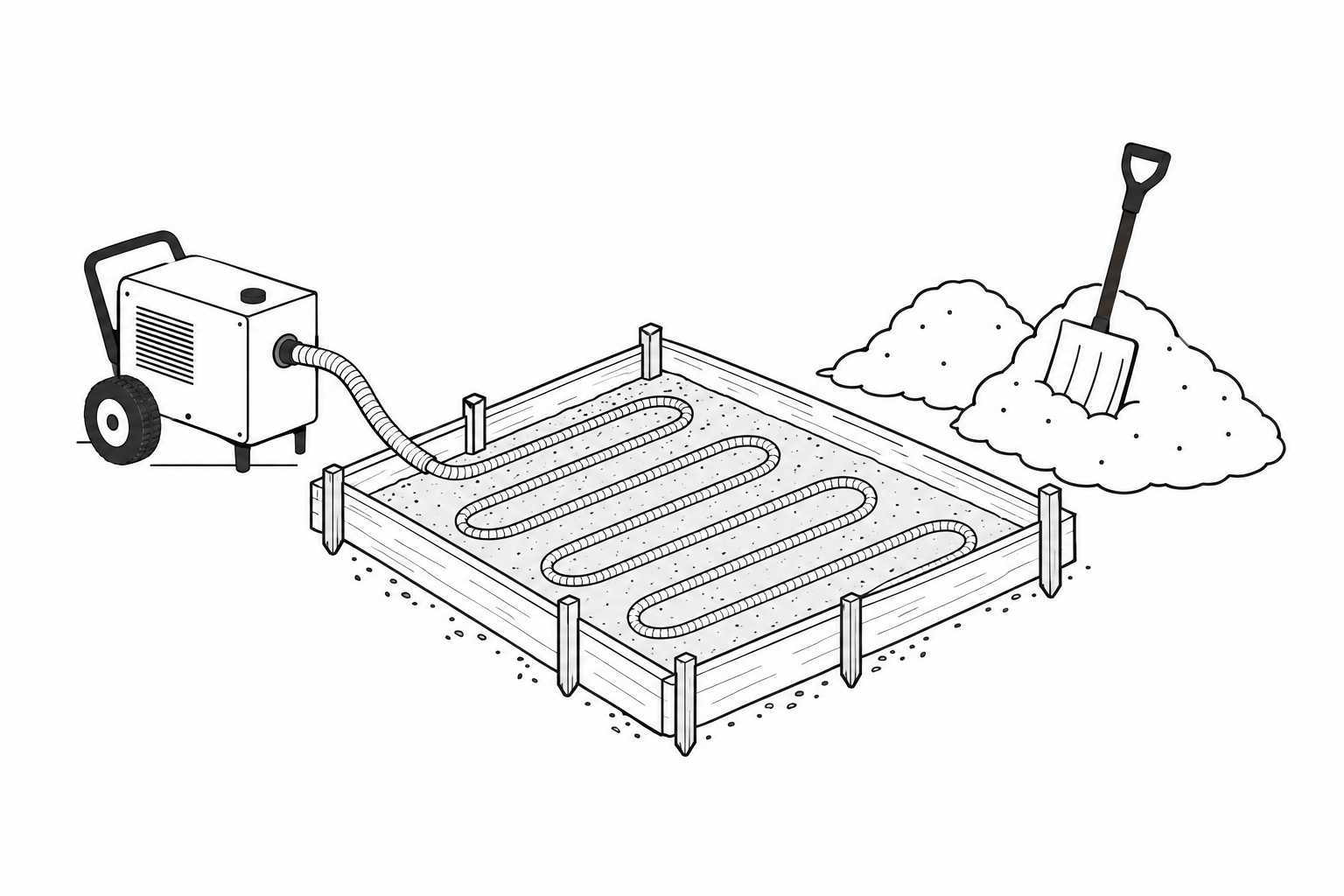
Ground heaters do this job. ACI defines a hydronic heater as a mobile system that heats frozen ground, formwork or concrete surfaces by pumping heated fluid through closed tubing (section 2.2). The price section lists a rental rate.
Have the protection on site before the truck is. ACI says tarps and blankets should be at the worksite before cold weather is likely to occur (section 4.1). Cemex adds that you should schedule the pour for the warmest part of the day.
The best cold weather concrete mix
Ask the plant for a cold weather concrete mix. These are the levers it has, from NRMCA CIP 27 unless noted:
- Heated mixing water. The simplest way to start warm (Cemex, above).
- More cement or high early strength cement. Both speed setting and strength gain. Cemex puts the extra cement at 100 to 200 lb per cubic yard.
- An accelerator. It speeds setting but does not stop concrete from freezing. It does not replace protection.
- The right accelerator for the steel in the slab. Calcium chloride should not exceed 2% of the cement weight. Use a non-chloride accelerator when corrosion of reinforcement is a concern. ACI warns that early strength from calcium chloride is not worth it if the slab cracks years later from corroding steel (section 3.1).
- Air entrainment. Use it wherever the slab will meet moisture and freezing and thawing. Cemex says that includes freezing during construction, with some hard-troweled interior floors excepted.
- The lowest practical slump. Do not add water at the site to make it flow. NRMCA says that delays setting and prolongs bleeding.
The price section shows what accelerators and heated water add per yard.
How to protect the slab after the pour
Cover it right away. NRMCA lists insulated blankets and tarps, and straw under plastic, as common measures.
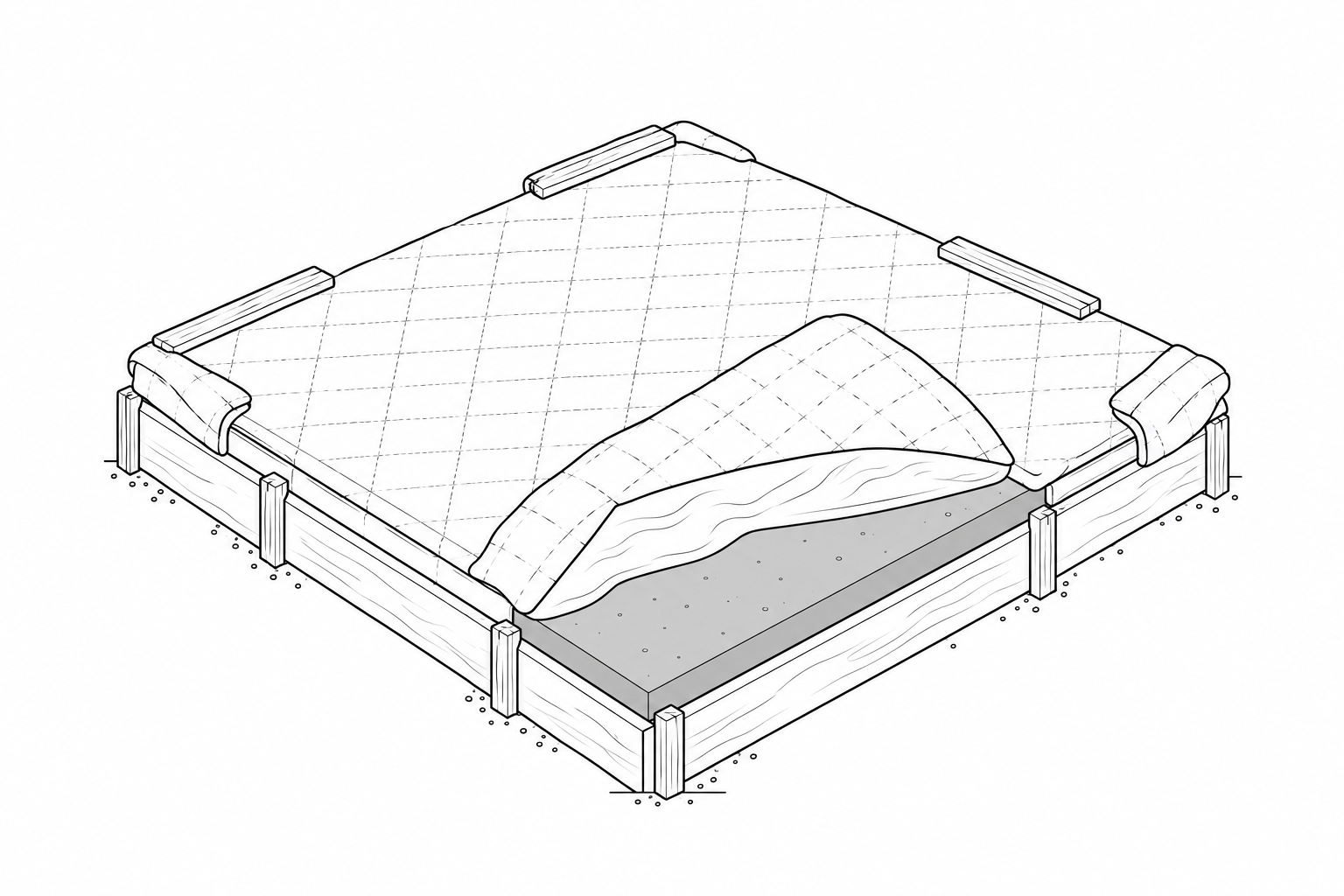
ACI is stricter about materials. Blankets should be moisture-proof, and ones filled with mineral wool, fiberglass, cellulose fibers or open-cell foam are not recommended because they perform badly when wet. ACI does not recommend straw, which is bulky, flammable, ineffective when wet and can mark the surface (section 9.2).
Plastic sheeting is cheap and useful. ACI says polyethylene sheeting keeps moisture in and, even alone, can greatly reduce heat loss on cold, windy days.
Give the edges extra cover. NRMCA says corners and edges are the most susceptible to heat loss.
Do not cure with water. ACI says water curing can leave the concrete too wet when protection comes off, which lowers its resistance to the next freeze (section 3.1). NRMCA recommends a curing compound, or impervious paper or plastic sheets, on slabs.
If you heat an enclosure, vent the heater. Exhaust from fuel-burning heaters can leave the surface dusty. NRMCA calls the cause carbonation, and ACI says the gas affects surfaces less than 24 hours old (section 2.2).
Take the covers off in stages. ACI says to let the surface temperature fall gradually over the following 24 hours (section 3.1). NRMCA warns of thermal shock and cracking when the surface and core differ by more than about 35°F.
How long a new slab needs protection from frost
ACI’s Table 7.2 gives protection periods. A day means 24 hours, and the concrete has to stay at or above the recommended minimum temperature the whole time.
| Service condition | Normal-set concrete | Accelerated-set concrete |
|---|---|---|
| No load, not exposed | 2 days | 1 day |
| No load, exposed | 3 days | 2 days |
| Partial load, exposed | 6 days | 4 days |
| Full load | See ACI Chapter 8 | See ACI Chapter 8 |
For an outdoor slab that carries no load, the “No load, exposed” row is the closest fit. A slab that will carry load sooner falls on a lower row. ACI also says these times are not exact. Ask the contractor which row they are planning to, and for how long they will keep the covers on.
If it freezes the night after the pour
Even when the weather is not “cold” by definition, such as fall or spring in cold climates, ACI wants every concrete surface protected from unexpected freezing for at least the first 24 hours (section 4.2). It adds that 24 hours does not guarantee good strength gain, especially if colder weather follows.
Keep blankets and plastic on hand for any pour in the shoulder seasons. If a young slab did freeze, ask the contractor to have its strength tested before building on it.
What a cold-weather pour adds to the price
Pouring concrete in cold weather adds charges, but the price lists we found do not show one cold-weather price. They list separate charges, and each is billed a different way.
Published supplier examples
| Charge | Price | Supplier | Price list |
|---|---|---|---|
| Winter concrete feeDec 1 through Mar 15 | $5.00 per cu yd | Gehring Construction & Ready-Mix, NE | Jan 1, 2026 |
| Winter concrete feeBeginning October 15 and April | $6.50 per cu yd | Consumers Concrete, MI | Jul 1, 2023 |
| Winter concrete feeDecember through March | $13.00 per cu yd | Consumers Concrete, MI | Jul 1, 2023 |
| Seasonally restricted loadThe price list does not say what a seasonally restricted load is. | $60.00 per load | Consumers Concrete, MI | Jul 1, 2023 |
| Heated mixing water | $5.00 per cu yd | Gehring Construction & Ready-Mix, NE | Jan 1, 2026 |
| Calcium chloride accelerator | $3.00 per 1% per cu yd | Consumers Concrete, MI | Jul 1, 2023 |
| Calcium chloride accelerator | $5.50 per 1% per cu yd | Gehring Construction & Ready-Mix, NE | Jan 1, 2026 |
| Non-chloride accelerator | $6.00 per 1% per cu yd | Consumers Concrete, MI | Jul 1, 2023 |
| Non-chloride accelerator | $6.00 per 1% per cu yd | Gehring Construction & Ready-Mix, NE | Jan 1, 2026 |
| Ground heater rentalThe rental page says one unit thaws ground up to 1,650 sq ft and cures concrete up to 2,200 sq ft. | $399.00 per day | Aspen Rent-All, CO | Page read Oct 12, 2026 |
| Ground heater rental | $1,999.00 per week | Aspen Rent-All, CO | Page read Oct 12, 2026 |
| Ground heater rental | $4,900.00 per 4 weeks | Aspen Rent-All, CO | Page read Oct 12, 2026 |
Scroll sideways to see all columns.
Treat these as examples of how the charges are built. They are not quotes. Prices differ by plant and by region, and the oldest list here took effect in July 2023. None of them is a national average, and this site does not publish one.
Read the table by how each charge is billed:
- Per cubic yard. Winter fees run $5.00 to $13.00 per cu yd across these lists. Gehring charges its fee from December 1 through March 15. Consumers lists one rate for “Beginning October 15 and April” and a higher one for December through March.
- Per percent of dose, per cubic yard. Accelerators are priced for each 1%, so a 2% dose costs twice the listed rate.
- Per load. Consumers adds a charge for each seasonally restricted load. Its list does not say what that means.
- Per day. A ground heater rents by the day, week or four weeks. Aspen Rent-All lists one unit as thawing ground up to 1,650 sq ft and curing concrete up to 2,200 sq ft.
None of these lists prints a price for the extra crew hours, or for the blankets and tarps ACI names as cold-weather costs. Ask a contractor to itemize them.
How big the winter charges are next to the whole job
The table below compares two of the charges with this site’s national-average estimate for a 4 in pad. The winter fee is billed per cubic yard. The heater is a flat rental, counted for one day.
| Row | 10×10 ft pad | 20×20 ft pad | 24×24 ft pad |
|---|---|---|---|
| Concrete orderedIncludes the waste allowance. | 1.3 cu yd | 5.2 cu yd | 7.5 cu yd |
| Base priceU.S. national average. | $1,460 – $2,890typical ≈ $2,170 | $3,010 – $5,980typical ≈ $4,500 | $3,950 – $7,850typical ≈ $5,900 |
| Winter fee, billed per cu yd$5.00 to $13.00 per cu yd | $7 – $17 | $26 – $68 | $38 – $98 |
| Share of base price | 0.3% – 0.8% | 0.6% – 1.5% | 0.6% – 1.7% |
| Ground heater, billed once$399.00 for one day. | $399 | $399 | $399 |
| Share of base price | 18% | 8.9% | 6.8% |
| Fee and heater together | $406 – $416 | $425 – $467 | $437 – $497 |
| Share of base price | 19% | 9.4% – 10% | 7.4% – 8.4% |
- Base price is this site's national-average estimate for a 4 in slab, the same figures as the size table on the concrete pad calculator. Every share below divides by the typical value shown under each range.
- The winter fee runs from the lowest to the highest winter fee in the supplier table above, $5.00 to $13.00 per cu yd: Gehring Construction & Ready-Mix (NE) at the low end, Consumers Concrete (MI) at the high end. It is billed on the cubic yards ordered, rounded to a tenth. It is a plant charge before any markup by the contractor who passes it on.
- The heater is one day of one unit (Aspen Rent-All, CO), counted once whatever the pad size. Its rental page lists one unit as covering a much larger area than any pad here, so no pad needs a second one. A longer protection period means more rental days.
- Left out: accelerators and heated water (optional, and listed above), insulating blankets, and the crew's extra hours. ACI names those costs, but none of the price lists above prints a price for them. A real quote for a winter pour will be higher than this table.
The two kinds of charge move in opposite directions as the pour grows. A per-yard winter fee is 0.3% to 0.8% of the base price on the 10×10 pad and 0.6% to 1.7% on the 24×24 pad. A flat charge goes the other way. One day of heater rental is 18% of the small pad’s price and 6.8% of the large one’s.
The reason is how the base price is built. This site’s estimate adds a fixed mobilization fee to a per-yard marginal cost, so the price per cubic yard falls as the pour grows. A per-yard fee is a bigger share of a cheaper yard. A one-time charge is spread over a bigger bill.
A flat price per square foot would keep the per-yard share level and miss this. The methodology page explains the model.
On a small pad, then, the flat charges decide how much winter adds. On a large pour, the per-yard fees weigh more. The calculators on this site price a pour at normal-season rates and do not add a winter charge. Use them for the base price: the concrete pad calculator, the concrete driveway cost page and the concrete yard calculator for the volume to order.
Pour now or wait for spring
ACI leaves the decision about pouring concrete in cold weather to the owner. The work costs extra, it says, but it can keep a project on schedule, and the owner should decide whether the extra cost is a good investment or whether it is more cost-effective to wait for mild weather (section 3.3).
If nothing depends on the slab this winter, waiting avoids every charge above. If a schedule does depend on the slab, go ahead and set aside money for protection. ACI is blunt about the one place not to save: neglecting protection against early freezing can mean immediate destruction or permanently weakened concrete.
Pouring concrete in cold weather: common questions
How cold is too cold to pour concrete?
No air temperature settles how cold is too cold to pour concrete. NRMCA’s guide gives no cutoff. It sets the concrete’s temperature as placed and the protection afterward. If the ground is frozen and you cannot thaw it, wait.
Is winter a good time to pour concrete?
It can be, and it costs more. See the price section for what suppliers charge, and the section on pouring now or waiting for how to decide.
How long after pouring do you have to worry about freezing?
Until the slab reaches about 500 psi, which takes about 48 hours at 50°F and longer when it is colder. ACI’s protection periods run from 1 to 6 days depending on the slab’s use.
What is the best temperature to pour concrete?
The best temperature to pour concrete is the placement temperature in the table above, with the ground thawed and clear of snow and ice.
Related calculators
Figures on this site are planning estimates. How we estimate lists the formula, the data sources and the limitations.